Hallucination Checks
11 minute read
A schema can guarantee that a reply has the right shape. It cannot guarantee that what the reply says is true. A perfectly formed sentence such as “your refund of $118.84 has been issued” is a serious failure if the refund is actually waiting for review.
These notes define a hallucination precisely for an agent (a claim not supported by what the turn actually observed), explain why it is costly, and develop a two-level check that runs after the model writes and before the user reads: cheap token-confidence signals from log-probabilities, and grounding of each atomic claim against evidence, using deterministic record checks and natural-language inference.
By the end of these notes you should be able to:
- distinguish intrinsic (contradicted) from extrinsic (unsupported) hallucinations;
- explain how NLI decides entailment, and why embedding similarity cannot;
- use log-probabilities as a cheap first signal while knowing their limits;
- describe a repair, trim and withhold policy for replies that fail.
In Guardrails, Pydantic checked the shape of a reply: a non-empty string, the right fields, the right types. But a perfectly shaped reply can still say something false: “Your refund of $118.84 has been issued”, when the refund is actually queued for review.
These notes are about the second check: is what the reply says true, given what the agent actually observed? In the CSA, every drafted reply gets a hallucination-check card in the trace with two levels: token confidence (how sure the model was of each sentence) and NLI entailment (each claim, the evidence it was checked against, and the verdict).
A working definition from the summarisation literature (Maynez et al., 2020; Ji et al.’s survey, 2023): a hallucination is output that is not supported by the source. It comes in two kinds:
| Intrinsic (contradicted) | Extrinsic (unsupported) | |
|---|---|---|
| Meaning | The output contradicts the source | The output says something the source doesn’t contain |
| Example | Record says “queued for review”; reply says “issued” | Reply promises “within 24 hours”; nothing in the evidence says so |
| Can it be true? | No | Possibly, but you can’t tell from here |
A hallucination check asks, for each thing the reply asserts: is it entailed by what the agent observed?
Three real-world shapes of the same failure:
- Airline: in Moffatt v. Air Canada (2024), the airline’s website chatbot told a customer he could claim a bereavement fare refund after travel. The policy said otherwise. The tribunal held the airline responsible for what its chatbot said.
- Law: in Mata v. Avianca (2023), lawyers filed a brief citing cases ChatGPT had invented, complete with invented quotes. The court sanctioned them.
- Support agents: a refund was queued for review, but the draft says “your refund has been issued”. A customer told money is coming plans around it.
The common thread: the reply was fluent, specific and confident. Nothing in its tone said “guess”. That’s why a hallucination can’t be caught by reading the reply; it has to be checked against the evidence.
graph TD
    D["Decompose · atomic claims"] --> L1["L1 · Confidence · token logprobs"] --> L2["L2 · Grounding · records, then NLI"] --> R["Repair once · with the evidence"] --> T["Trim · withhold · what still fails goes"]
    classDef c1 fill:#dcfce7,stroke:#15803d,stroke-width:2px,color:#14532d
    classDef c2 fill:#dbeafe,stroke:#1d4ed8,stroke-width:2px,color:#1e3a8a
    classDef c3 fill:#ffedd5,stroke:#c2410c,stroke-width:2px,color:#7c2d12
    classDef c4 fill:#f3e8ff,stroke:#7e22ce,stroke-width:2px,color:#581c87
    classDef c5 fill:#fee2e2,stroke:#b91c1c,stroke-width:2px,color:#7f1d1d
    classDef c6 fill:#ccfbf1,stroke:#0f766e,stroke-width:2px,color:#134e4a
    class D c1
    class L1 c2
    class L2 c3
    class R c4
class T c5- Decompose the reply into atomic claims: sentences, then split again at conjunctions and semicolons.
- Level 1, token confidence: how sure was the model of the words it wrote? Free with the completion.
- Level 2, grounding: is each claim entailed by the evidence? Deterministic checks for records first, then NLI.
- Repair: one bounded rewrite, with the evidence in front of the model.
- Trim or withhold: whatever is still refuted is removed; if nothing survives, a withheld reply goes instead.
Natural Language Inference (NLI; SNLI, Bowman et al., 2015; MultiNLI, Williams et al., 2018): given a premise and a hypothesis, does the premise entail the hypothesis, contradict it, or neither (neutral)?
| Premise: “The forecast for Pune on 2 October is light drizzle with a high of 32.5 °C.” | Verdict |
|---|---|
| “It will drizzle in Pune on 2 October.” | Entailment |
| “It will be dry in Pune on 2 October.” | Contradiction |
| “Pune’s railway station has six platforms.” | Neutral: not about this |
For a hallucination check, premise = evidence and hypothesis = the claim: entailed → supported; contradicted → refuted; neutral → unverified. Three verdicts, not two: “I can’t confirm this” is different from “this is false”.
Embeddings find, NLI decides. Two models, two jobs:
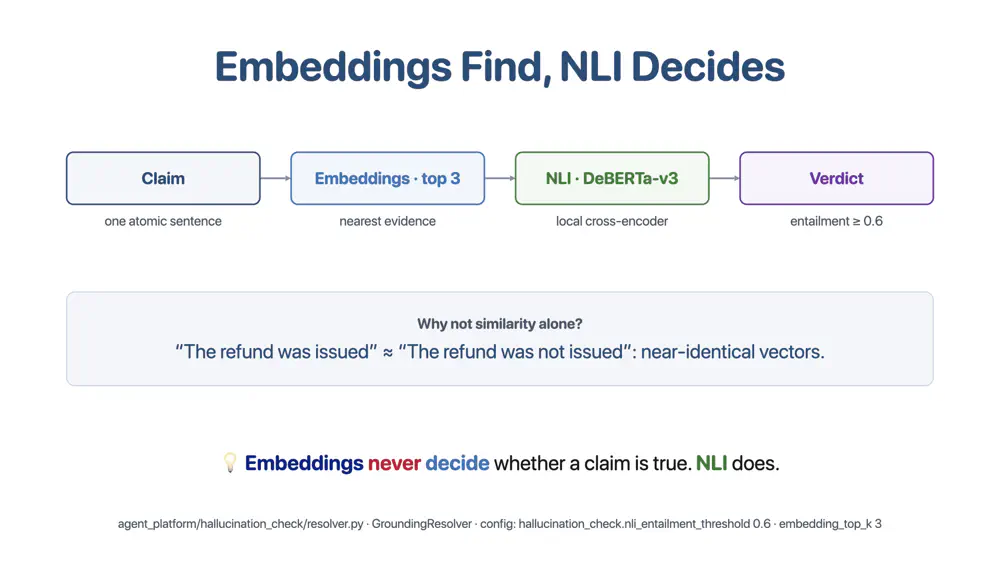
- Embeddings retrieve: for each claim, find the top 3 most similar evidence sentences. But similarity is not truth: “the refund was issued” and “the refund was not issued” are near-identical vectors.
- NLI decides: a cross-encoder (a local DeBERTa-v3 NLI model, a BERT-family encoder) reads claim and evidence together and sees the negation. Entailment ≥ 0.6 → supported.
Before NLI: what does the reply actually claim, and what kind of claim is it?
Decompose finely. “The refund has not been initiated; the status shows none” was once checked as a single claim against evidence matching only half of it, so a half-verbatim sentence scored as entirely unsupported. Splitting at semicolons and conjunctions makes each piece checkable on its own.
Classify: the class decides what may ground it.
| Class | Example | Grounded by |
|---|---|---|
| record | “$18.70 has been refunded.” | Tool results only: only a record can show what happened to this case |
| rule | “You’ll hear back soon.” | The policy that makes the promise |
| conversational | “Thanks for reaching out.” | Nothing: it asserts nothing, so it isn’t checked |
Checking conversational sentences is how a courteous reply once got flagged as a hallucination.
NLI is the workhorse, but it has known blind spots, each with a mitigation:
| Limit | Symptom | Mitigation |
|---|---|---|
| Facts across lines | A web page states one fact over several short lines; a sentence joining them is entailed by no single premise → neutral | Passage windows (support-only), and a confirm-only second model |
| Conditional rules | “before it ships…” vs “once it ships…” reads as a contradiction | Rule claims checked only against policy |
| Numbers and states | $118.84 ≈ $118.48 to NLI; state machines are opaque to it | Direct check: read the field |
| Long premises | Truncated at 512 tokens | Retrieve the best sentences first |
The second-opinion model is instructive: on one test turn it confirmed 5/5 true claims where NLI confirmed 2/5, but it also accepted a wrong relation. So it is allowed to confirm, never to refute.
A record claim is settled without a model whenever a field can settle it. Each finding gets a reason code:
| Reason code | Means |
|---|---|
CLAIM_WITHOUT_TOOL_EVIDENCE | A claim about this case with no tool result behind it |
IDENTIFIER_MISMATCH | An order id the record doesn’t hold |
AMOUNT_MISMATCH | An amount not in the record |
RECORD_STATE_MISMATCH | A state the refund state machine rules out ("issued" vs “queued for review”) |
NOT_EXECUTED | The claim reports the effect of a call that was refused |
A refused call (e.g. the Gatekeeper said ESCALATE or DENY) is written into the evidence as NOT EXECUTED: it grounds “that was refused”, never “it happened”. Only what the direct check can’t place goes on to NLI.
For every token it emits, a model can return the log-probability it assigned to that token (the output of the final softmax over the vocabulary). A model that is guessing spreads probability over several candidates, so the token it picks carries a low probability.
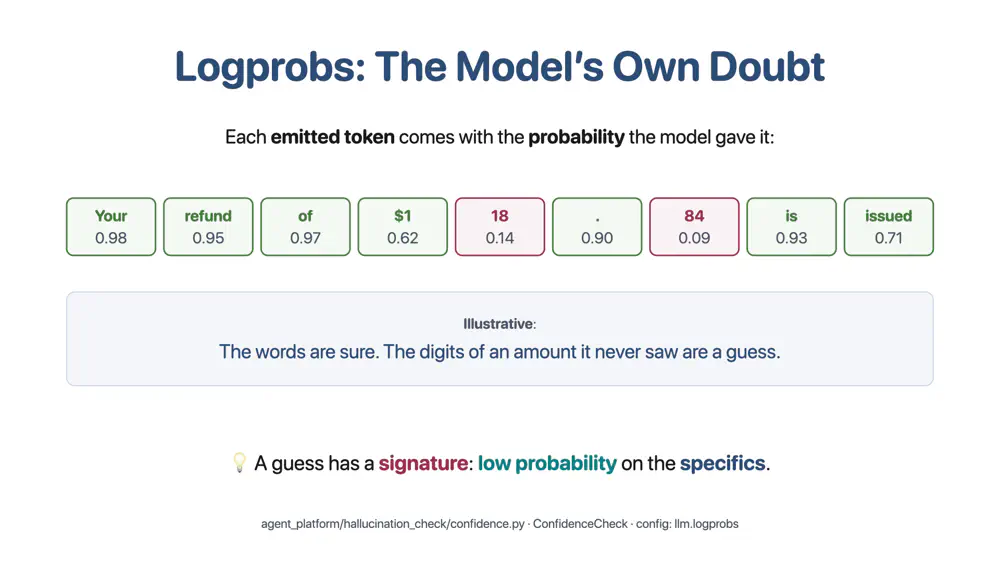
The words are sure; the digits of an amount the model never saw are a guess. Per sentence we compute:
\[\bar{p} = \frac{1}{|C|}\sum_{t \in C} e^{\log p(t)} \qquad \text{low share} = \frac{|\{t \in C : p(t) < 0.2\}|}{|C|}\]where \(C\) is the sentence’s content tokens (grammar words are left out: a low-probability “the” means another phrasing, not a guess). Asking for logprobs costs nothing extra.
Two deterministic cuts. Confidence is not truth, so every claim still goes to grounding. But logprobs alone may remove a sentence in exactly two cases:
- Degenerate sentence: content tokens average below 0.5 → cut, whatever grounding says.
- Shaky specific: an id, amount, date or number written with probability below 0.2 → its claim is cut unless the record confirms it. That is the made-up-number signature.
Otherwise a sentence is merely marked LOW (mean under 0.6, or more than 25% of tokens under 0.2): information, not a removal.
What logprobs can’t tell you:
| Limit | So |
|---|---|
| Confidently wrong: a learned false fact is stated with high probability | Logprobs measure doubt, not error: level 2 runs on every claim |
| Over-confidence: instruction-tuned models aren’t calibrated (Kadavath et al., 2022; GPT-4 report) | Thresholds are per model, in config |
| Not always returned by every provider | The trace says so; grounding runs anyway |
| Reasoning tokens are generated too | Only the tokens that wrote the sentence are scored |
Each of these is legitimate; each has a cost that doesn’t fit an agent answering a customer in real time on hosted models:
| Method | Accuracy | Primary Trade-off/Bottleneck |
|---|---|---|
| Embedding + NLI | Medium | Blind to multi-line facts and math errors |
| Hybrid + Reranker + NLI | High | Still bound by rigid NLI token limits (e.g., 512 tokens) |
| Hybrid + Reranker + LLM-Judge (CoT) | Very High | Financial cost scales with usage; Judges can still hallucinate judges hallucinate too |
| Semantic Entropy / Self-Consistency | Exceptional | N× cost multiplier; requires expensive meaning clustering |
Note:
Self-Consistency looks for exact consensus, while Semantic Entropy looks for consistent meaning.
The check is organised in levels, and every agent’s trace card reads the same way:
- Level 1 is the platform’s, identical for every agent: token confidence.
- Level 2 is whatever grounds this agent’s claims: NLI against evidence for a reply (CSA, RA answers), or a figure found in a query result for an answer computed from one.
What happens to a reply that fails:
graph LR
    F[Failed claims] --> R["Repair once · evidence + refuted claims in the prompt"]
    R --> C{Still refuted?}
    C -->|no| S[Send]
    C -->|yes| T["Trim · remove those sentences"]
    T --> N{Anything left?}
    N -->|yes| S
N -->|no| W["Withhold · 'I couldn't verify all of the details...'"]- Repair once: one bounded rewrite, with the evidence and the refuted claims listed. If the draft has no evidence behind its business claims, the deterministic gate runs first: asking a model to rewrite with nothing to rewrite from produces a second hallucination.
- Trim: what’s still refuted is removed, sentence by sentence.
- Withhold: if nothing survives, a configured withheld reply goes instead.
Whether a person then reviews it is the agent’s decision, not the guardrail’s.
status: queued_for_review, amount: 118.84. Which checks catch it, and what does the customer receive?- Hallucination = not supported by what the turn observed: contradicted or unsupported.
- NLI decides; embeddings only retrieve. Records are read, not inferred.
- Logprobs are level 1: cheap doubt, two deterministic cuts, never the whole check.
- Repair once, trim, withhold. Never ask the author to grade itself.
Check each claim against what the agent saw, not how sure it sounded.
- Maynez et al., On Faithfulness and Factuality in Abstractive Summarization ACL (2020).
- Ji et al., Survey of Hallucination in Natural Language Generation ACM Computing Surveys (2023).
- Moffatt v. Air Canada, 2024 BCCRT 149 a company held responsible for its chatbot.
- Mata v. Avianca, Inc. (S.D.N.Y. 2023) sanctions for invented case citations.
- Bowman et al., A Large Annotated Corpus for Learning Natural Language Inference (SNLI) EMNLP (2015).
- Williams et al., A Broad-Coverage Challenge Corpus for Sentence Understanding through Inference (MultiNLI) NAACL (2018).
- Kadavath et al., Language Models (Mostly) Know What They Know (2022): calibration.
- Manakul et al., SelfCheckGPT (2023).
- Farquhar et al., Detecting Hallucinations in Large Language Models Using Semantic Entropy Nature (2024).
- Dhuliawala et al., Chain-of-Verification Reduces Hallucination in Large Language Models (2023).
- Min et al., FActScore (2023).
- Azaria & Mitchell, The Internal State of an LLM Knows When It’s Lying (2023).