Model Interpretability
Model Interpretability
2 minute read
House Price Prediction
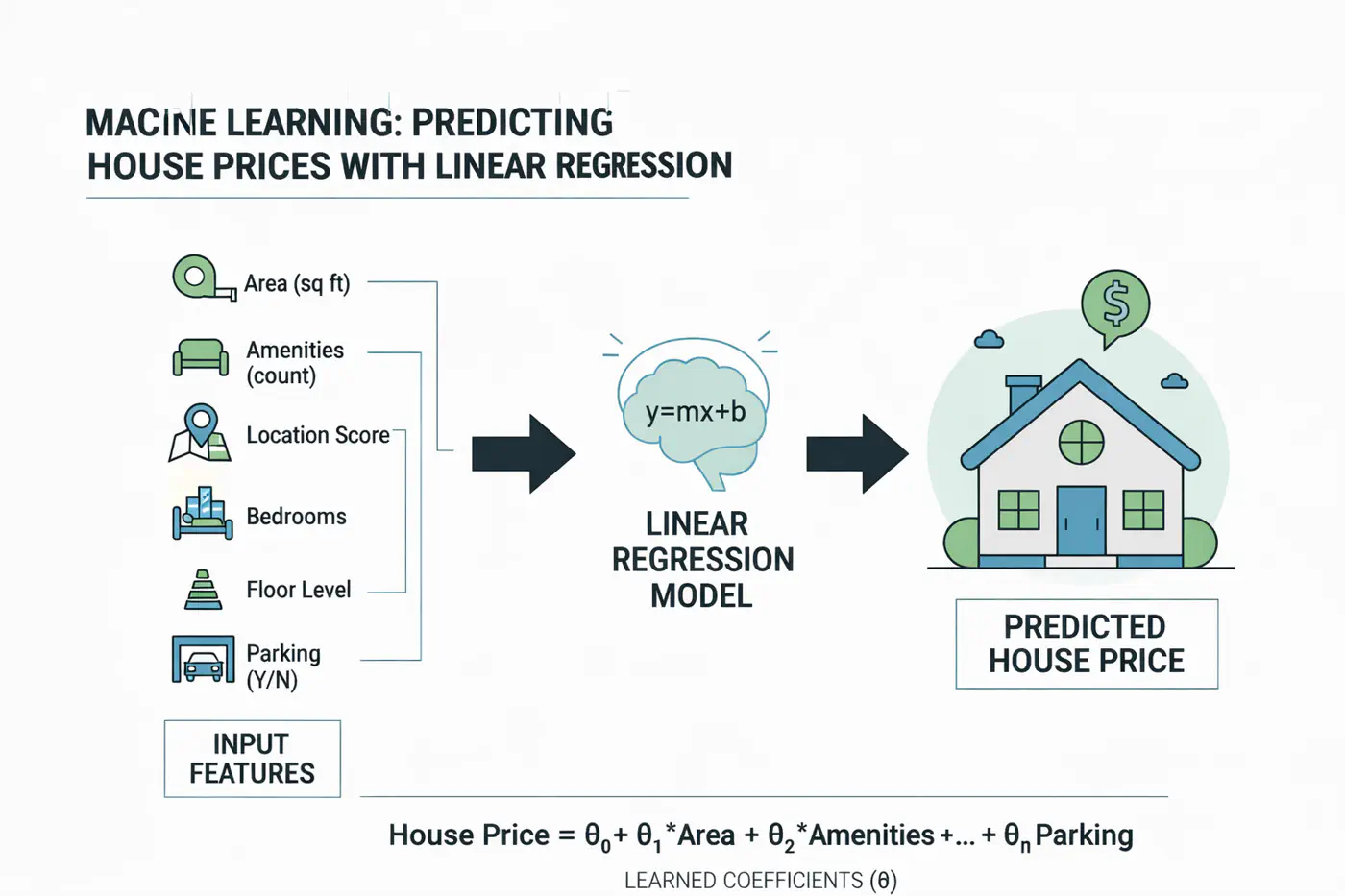
Can we explain why the model made a certain prediction ?
👉 Because without this capability the machine learning is like a black box to us.
👉 We should be able to answer which features had most influence on output.
⭐️ Let’s understand ‘Feature Importance’ and why the ML model output’s interpretability is important ?
Feature Importance
\[\hat{y_i} = w_0 + w_1x_{i_1} + w_2x_{i_2} + \dots + w_dx_{i_d}\]\[w_1 > w_2 : f_1 \text{ is more important feature than } f_2\]\[
\begin{align*}
w_j &> 0: f_j \text { is directly proportional to target variable} \\
w_j &= 0: f_j \text { has no relation to target variable} \\
w_j &< 0: f_j \text { is inversely proportional to target variable} \\
\end{align*}
\]
Note: Weights 🏋️♀️ represent the importance of feature with standardized data.
Why Model Interpretability Matters ?
💡 Overall model behavior + Why this prediction?
- Trust: Stakeholders must trust predictions.
- Model Debuggability: Detect leakage, spurious correlations.
- Feature engineering: Feedback loop.
- Regulatory compliance: Data privacy, GDPR.
Trust
⭐️ Stakeholders Must Trust Predictions.
- Users, executives, and clients are more likely to trust and adopt an AI system if they understand its reasoning.
- This transparency is fundamental, especially in high-stakes applications like healthcare, finance, or law, where decisions can have a significant impact.
Model Debuggability
⭐️ By examining which features influence predictions, developers can identify if the model is using
misleading or spurious correlations, or if there is data leakage
(where information not available in a real-world scenario is used during training).
Feature Engineering
⭐️ Insights gained from an interpretable model can provide a valuable feedback loop for domain experts and engineers.
Regulatory Compliance
⭐️ In many industries, regulations mandate the ability to explain decisions made by automated systems.
- For instance, the General Data Protection Regulation (GDPR) in Europe includes a “right to explanation” for individuals affected by algorithmic decisions.
- Interpretability ensures that organizations can meet these legal and ethical requirements.
End of Section