Regularization
Regularization in Logistic Regression
less than a minute
Question
What happens to the weights of Logistic Regression if the data is perfectly linearly separable?
Answer
The weights will tend towards infinity, preventing a stable solution.
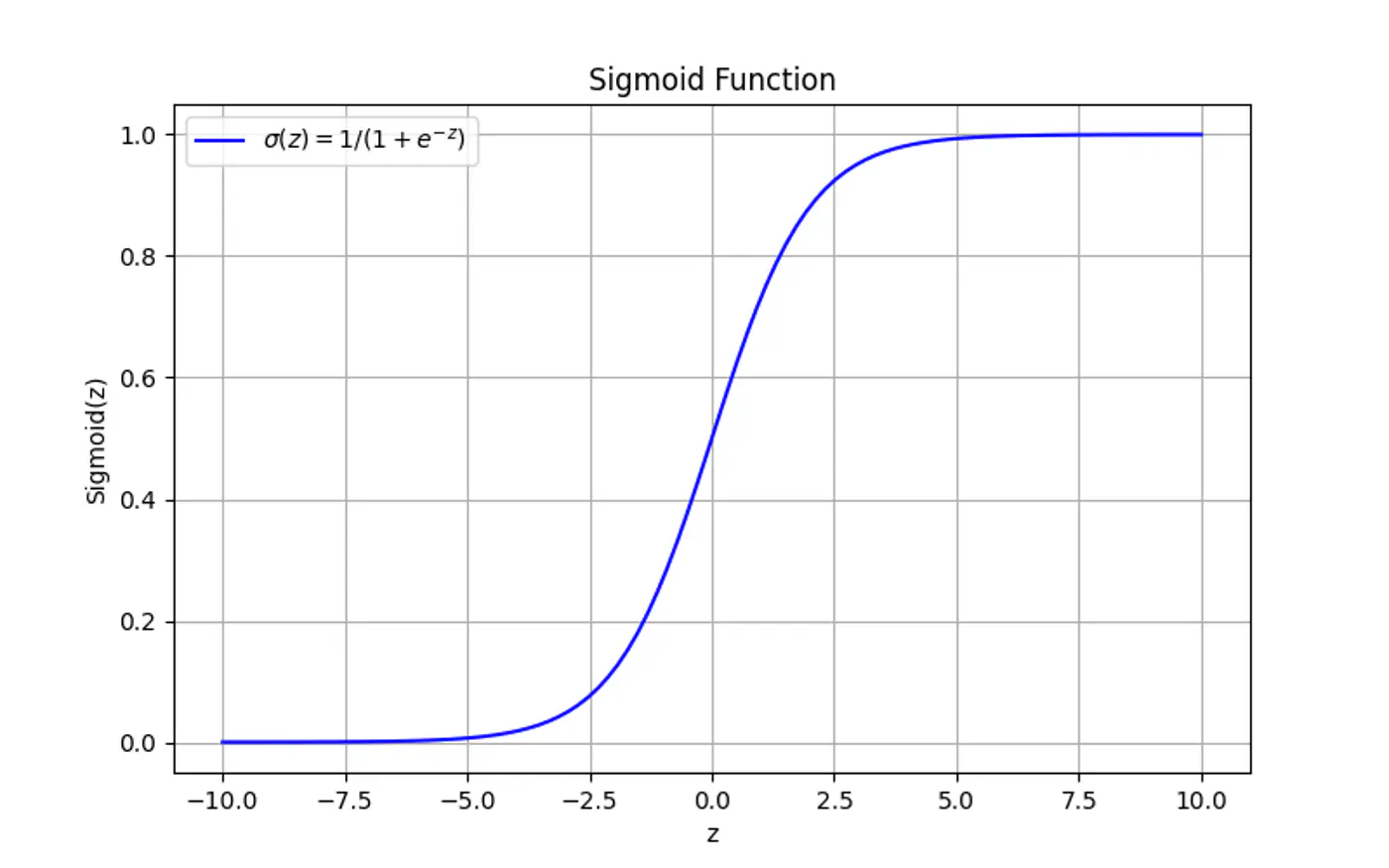
The model tries to make probabilities exactly 0 or 1, but the sigmoid function never reaches these limits, leading to extreme weights to push probabilities near the extremes.
Distance of Point: \(z = \mathbf{w^Tx} + w_0\)
Prediction: \(\hat{y} = \sigma(z) = \frac{1}{1 + e^{-z}}\)
Log loss: \(-[y_ilog(\hat{y_i}) + (1-y_i)log(1-\hat{y_i})] \)
Why is it a problem ?
Overfitting:
Model becomes perfectly accurate on training data but fails to generalize, performing poorly on unseen data.
Model becomes perfectly accurate on training data but fails to generalize, performing poorly on unseen data.
Solution
Regularization:
Adds a penalty term to the loss function, discouraging weights from becoming too large.
Adds a penalty term to the loss function, discouraging weights from becoming too large.
L1 Regularization
\[
\begin{align*}
\underset{w}{\mathrm{min}}\ J_{reg}(w) = \underset{w}{\mathrm{min}}\
& \underbrace{- \sum_{i=1}^n [y_i\log(\hat{y_i}) + (1-y_i)\log(1-\hat{y_i})]}_{\text{Log Loss}} \\
& \underbrace{+ \lambda_1 \sum_{j=1}^n |w_j|}_{\text{L1 Regularization}} \\
\end{align*}
\]
L2 Regularization
\[
\begin{align*}
\underset{w}{\mathrm{min}}\ J_{reg}(w) = \underset{w}{\mathrm{min}}\
& \underbrace{- \sum_{i=1}^n [y_i\log(\hat{y_i}) + (1-y_i)\log(1-\hat{y_i})]}_{\text{Log Loss}} \\
& \underbrace{+ \lambda_2 \sum_{j=1}^n w_j^2}_{\text{L2 Regularization}} \\
\end{align*}
\]